
 Menu
MenuAnodes
An anode can be described as an electrode from which electrical current is discharged. Anodes are an essential and integral part of any Cathodic Protection installation.
Direct CP supplies anodes of all types, in all materials and in any configuration. We can design sacrificial anode CP systems, supply and install anodes and CP systems to suit the specific requirements of your structure.
ABOUT ANODES
There are two types of Cathodic Protection systems. Each type of CP system uses a different type of anode. An anode can be described as an electrode from which electrical current is discharged.
1: Sacrificial anode, and
2: Impressed current
An anode can be described as an electrode from which electrical current is discharged.
Sacrificial anodes generate their own electrical current when connected to another dissimilar metal such as steel and when immersed in an electrolyte such as soil or water, much like a zinc/carbon battery.
An impressed current anode discharges current when an external electrical potential is applied between it and a metal structure. Impressed current anodes installed in water are suspended in the water some distance from the structure to be protected, whilst impressed current anodes installed in soil are generally (but not always) installed in a surrounding bed of carbonaceous backfill.
The selection of the correct anode is considered during the anode or Cathodic Protection system design process and considers many factors, including current output, electrolyte resistivity, required lifespan and environmental conditions.
SACRIFICIAL ANODES
Sacrificial anodes are generally cast onto a blast cleaned steel rod or flat bar core, this enables the anode material to be supported and fixed to a structure via the core. Sacrificial anodes are often located closer to the protected structure than impressed current anodes as their surrounding electrical gradient is usually significantly lower. Sacrificial anodes installed in water are often fixed directly to the structure with minimal or negligible separation between the anode and the structure.
MAGNESIUM (Mg). Frequently used in soil and fresh water, including hot water tanks. Often supplied as a round or rectangular rod in a calico sack surrounded by gypsum/sodium bentonite powder backfill (soil and fresh water). An insulated copper cable is connected to the steel core of the anode and the connection insulated using mastic lined heat shrink sleeving or potted in electrical epoxy casting resin (no copper cable core exposed to the electrolyte). The cable connects the anode to the structure to be protected. Magnesium anodes can be supplied as a ribbon with a full length steel core. High and Low potential versions are available as required.
ZINC (Zn). (Brackish water and low resistivity soil, not HOT (>50 degrees C ) water. Can be supplied as a rod, bar, slab or ingot of a variety of shapes, sizes and different weights as required by the CP system designer. Sometimes supplied in low resistance backfill as per magnesium above. Can be supplied as a ribbon with a full length steel core and often used in earthing systems.
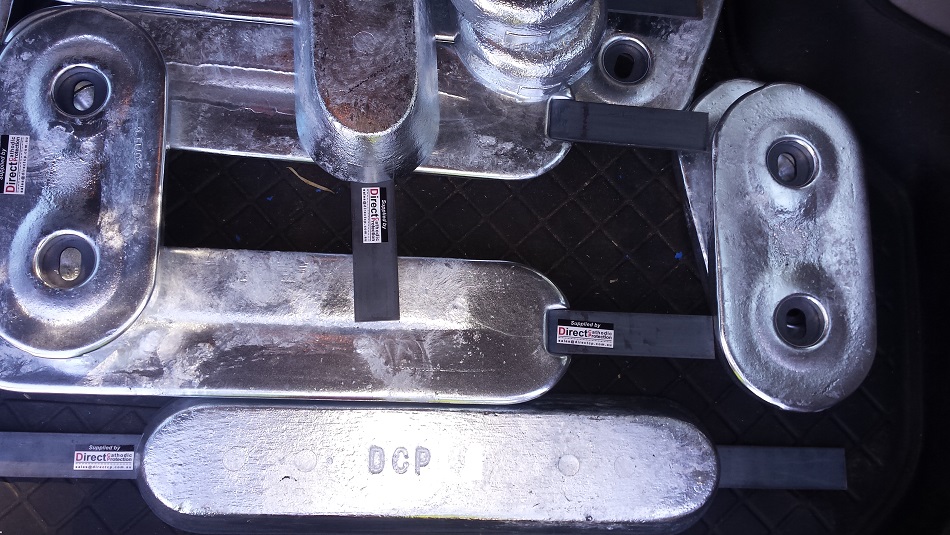
Sacrificial zinc anodes
ALUMINIUM (Al). (Sea water). Never supplied or used with a low resistance backfill. Aluminium anodes are generally used in marine applications. They can be supplied in rod, slab and ingot shapes with sizes from 1 to several hundred kilograms. Larger aluminium anodes are usually cast onto pipe sections as required for each particular application. They can be welded or bolted to the structure to be protected.
IMPRESSED CURRENT ANODES
Impressed current anode types are many and varied; their materials include the mundane mild steel, silicon iron alloys, lead silver alloys (marine) through exotic metals such as titanium and niobium, even ceramics are used in particular applications. Anode configurations include wire, rod, tube and even mesh.
Impressed current anode types range in size from small titanium wires inside heat exchanger/condenser end boxes to large lead/silver alloy anodes capable of giving 100+ amps dc output in large marine CP systems.
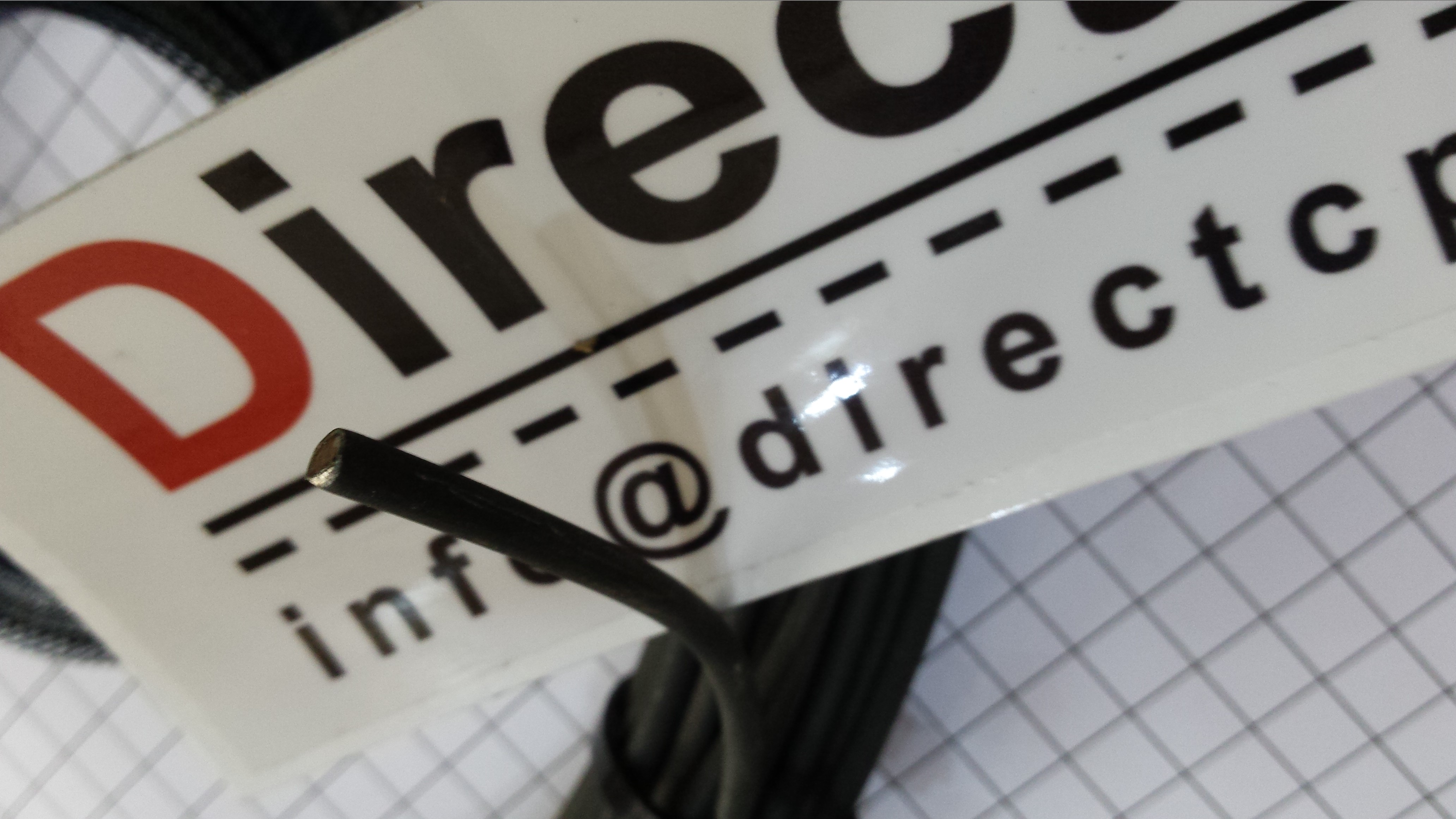
Titanium anode wire
MMO coated and copper cored – 4mm diameter
Gladstone, Perth,
Australia Wide Service